Facilities management is becoming more complex. Clients expect faster responses, greater transparency, better cost control and consistently high service standards across every asset. Meeting these expectations requires more than conventional processes. It requires connected systems, reliable operational data and technology that can help teams act faster and make better-informed decisions.
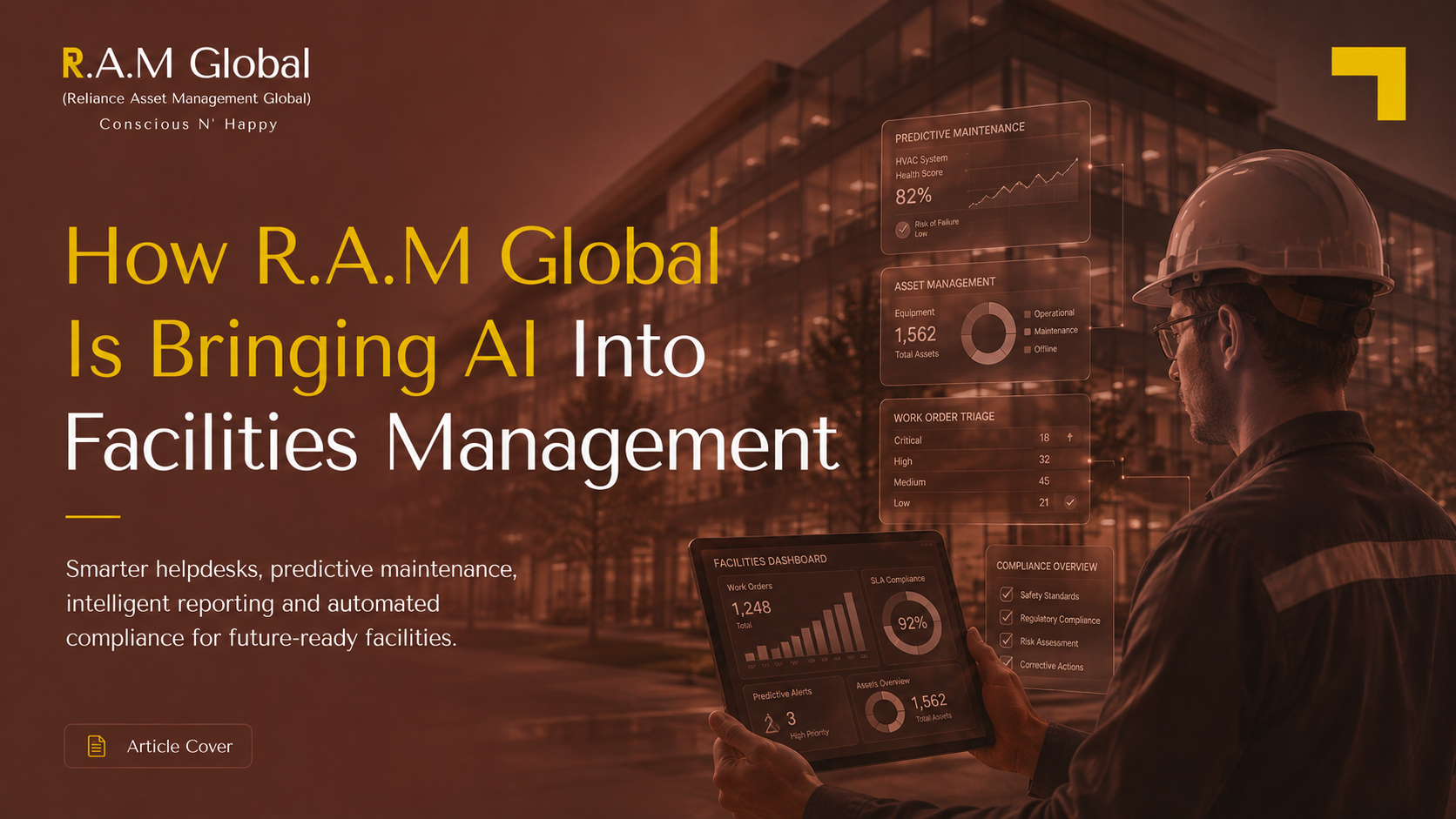
R.A.M Global is actively working to introduce artificial intelligence across its facilities management operations. Through a phased integration with its ERP, CAFM, helpdesk and reporting systems, the company aims to automate routine administrative work, identify operational risks earlier and provide teams with the information they need at the right time.
The objective is not to replace the experience of facilities management professionals. It is to strengthen their capabilities by reducing repetitive work, improving accuracy and allowing them to focus on service delivery, client relationships and critical operational decisions.
A More Intelligent, 24/7 Helpdesk
The helpdesk is one of the most important points of contact between a facilities management company and its clients. Delays in capturing, categorising or assigning requests can affect service quality and customer satisfaction.
R.A.M Global is working towards an AI-supported helpdesk that can operate around the clock. Service requests could be captured automatically, classified according to their nature and assigned to the appropriate team or technician.
This approach can help reduce missed complaints, improve response times and ensure that requests are recorded consistently. It also supports 24-hour customer service by making essential information available beyond conventional working hours.
Smarter Complaint Prioritisation
Not every service request carries the same level of urgency. A fire alarm, major water leakage or critical cooling failure requires a different response from a routine maintenance request.
AI-supported prioritisation can assess complaints using factors such as safety, operational impact, urgency, asset criticality and service-level agreements. Requests with the greatest potential impact can then be escalated immediately.
R.A.M Global is exploring this capability to help its teams resolve critical issues faster while using technicians, equipment and other resources more effectively.
Predictive Maintenance and Early Intervention
Traditional maintenance is often reactive, with action taken after a failure occurs. Predictive maintenance changes this by using asset data, maintenance records and performance trends to detect warning signs before equipment breaks down.
R.A.M Global is actively progressing towards predictive analysis within its operational systems. The technology could help identify unusual temperatures, vibration patterns, energy consumption or recurring faults associated with equipment such as HVAC systems, pumps and electrical assets.
Earlier intervention can reduce unplanned downtime, emergency repairs and long-term maintenance costs. It can also extend asset life and improve the reliability of critical building services.
Automated Invoice Verification
Invoice review can be time-consuming, particularly when teams must compare invoices manually with contracts, work orders, approved rates and completion records.
By integrating AI into its ERP processes, R.A.M Global aims to make invoice and payment reconciliation faster and more accurate. The system could flag mismatched values, duplicate charges, incomplete documentation or unapproved work before a payment is processed.
This would help reduce billing errors, prevent overpayments and minimise approval delays while giving finance and operations teams a clearer audit trail.
Photo-Based Work Verification
Photographic evidence is frequently used to confirm that maintenance and corrective work has been completed. However, manually reviewing large volumes of images can be difficult and inconsistent.
AI-assisted image analysis could compare before-and-after photographs, identify visible changes and help confirm whether the reported work has been completed. This would provide additional support to supervisors and quality teams rather than replacing their professional review.
For clients, the result would be stronger accountability, improved quality control and greater confidence in completed work.
Automated Compliance Management
Facilities management teams must oversee inspections, documentation, safety standards, risk assessments and corrective actions across multiple sites. Missing a deadline or failing to close an inspection finding can create operational and regulatory risks.
R.A.M Global is working towards systems that can convert inspection findings into assigned actions, track their progress and alert responsible teams as deadlines approach. AI could also help identify repeated compliance issues and highlight areas requiring management attention.
This would support a more consistent, traceable and audit-ready compliance process.
An AI Assistant for FM Teams
Operational information is often distributed across several systems, reports and dashboards. Finding the status of an asset, work order or SLA can take valuable time.
An AI assistant connected to approved company data could allow authorised teams to ask direct questions about assets, open tasks, maintenance schedules, service performance and operational risks. Instead of manually searching through multiple platforms, users could receive a concise response supported by relevant system records.
This capability could help managers and operational teams make faster decisions while maintaining appropriate access controls and data governance.
Intelligent Reporting and Forecasting
Reporting should do more than describe what has already happened. It should help decision-makers understand why performance changed and what may happen next.
R.A.M Global plans to use AI to analyse operational data, identify trends and support forecasting across areas such as work-order volumes, equipment risks, energy consumption, cost efficiency, SLA performance and space utilisation.
By turning large quantities of operational data into clearer insights, the company can support more confident planning, stronger cost control and continuous service improvement.
A Practical and Responsible Approach to AI
R.A.M Global’s AI journey is focused on practical operational value. The company is not introducing technology simply for the sake of innovation. Each proposed capability is intended to address a real facilities management challenge, whether that is a delayed complaint, an unexpected breakdown, an invoice mismatch or a compliance deadline.
Implementation is being approached progressively, with AI integrated into existing ERP, CAFM, helpdesk and reporting processes. Human oversight will remain essential, particularly for safety-critical decisions, technical approvals, compliance matters and client-facing actions.
By combining technology with the knowledge of experienced facilities management professionals, R.A.M Global is building a more responsive, transparent and future-ready service model.
The goal is clear: automate routine work, identify risks earlier, improve operational visibility and give people better tools to manage facilities more intelligently.